
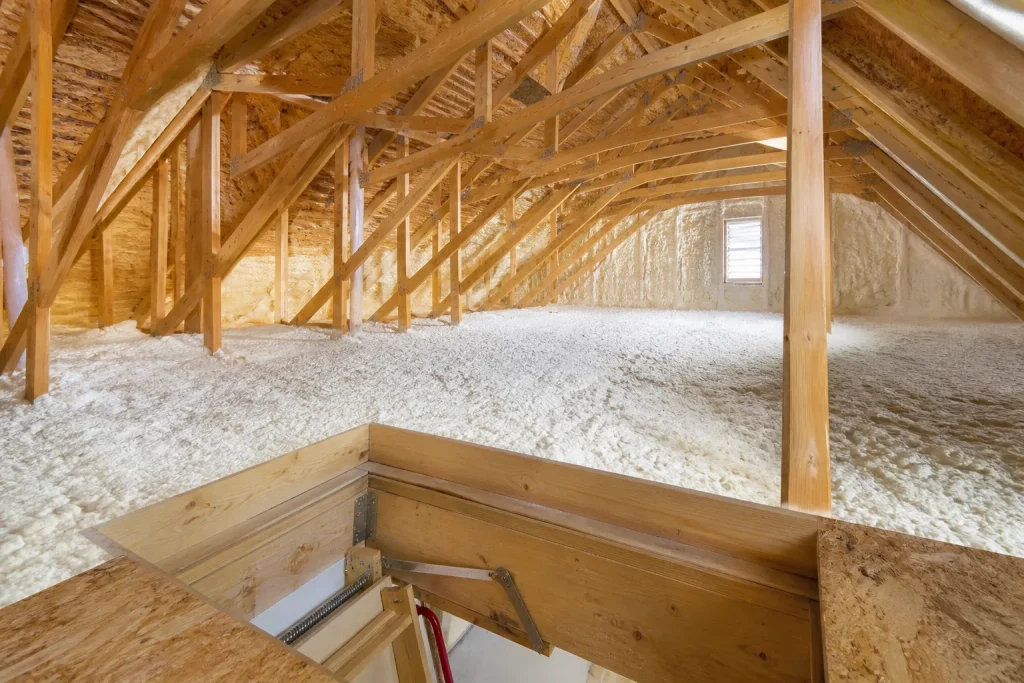
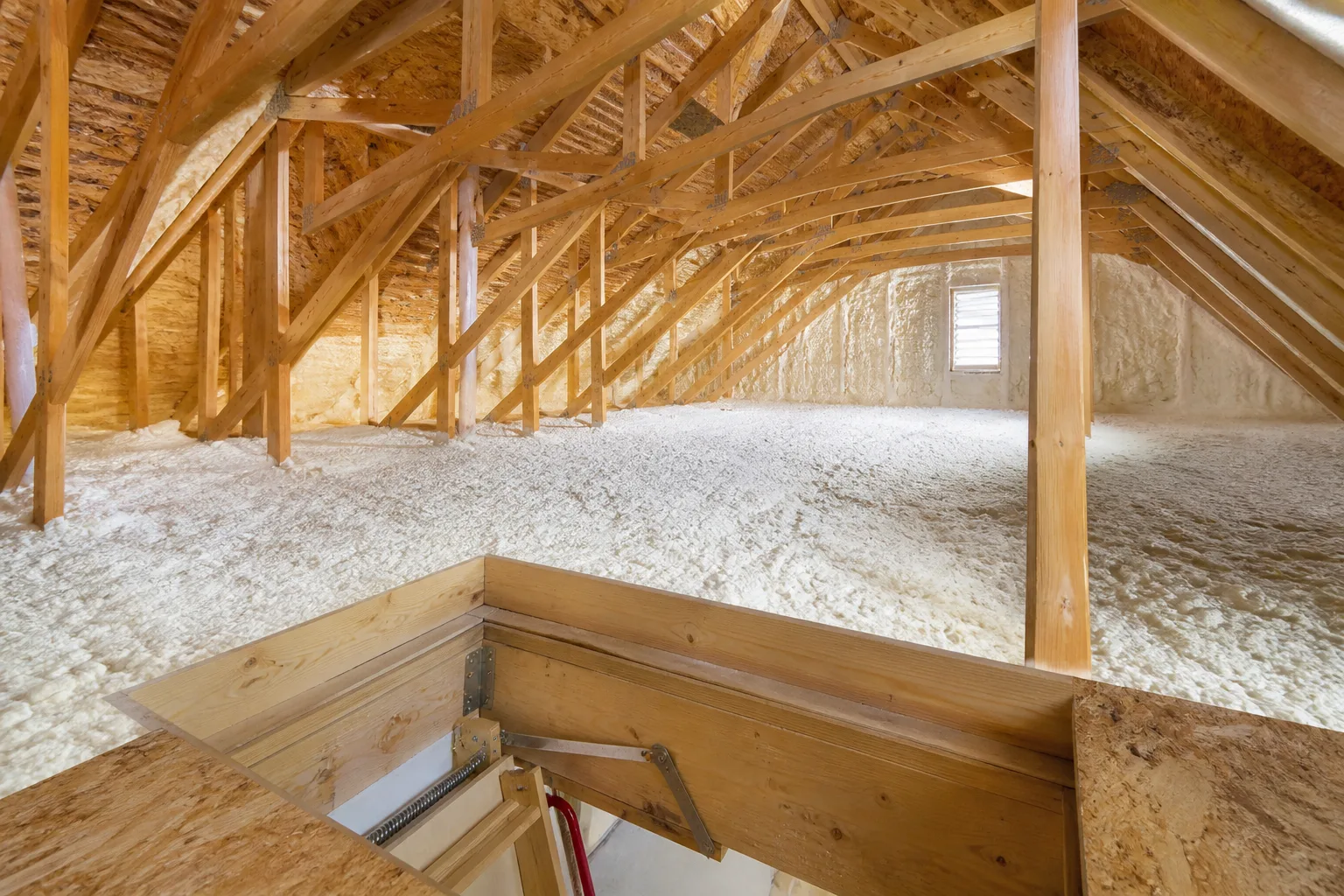
Demilec Attic Insulation in Summerlin: A Homeowner’s Guide
Demilec makes two fundamentally different spray foam products, and they behave in opposite ways under heat and moisture. Heaplok HFO closed-cell foam seals a roof deck tight and adds real structural rigidity; Sealection 500 open-cell foam is vapor-permeable and quieter underfoot. Choosing the wrong one for a Summerlin attic can mean trapped moisture in the roof deck rather than a performance upgrade. If you’d rather have a specialist sort out which fits your home, call (844) 320-4895.
What’s the difference between Demilec Heatlok HFO and Sealection 500?
Heatlok HFO is closed-cell foam: it cures rigid and dense, resists water vapor, and delivers roughly R-6.8 per inch. Sealection 500 is open-cell foam: it cures soft and spongy, allows moisture vapor to pass through, and delivers roughly R-3.7 per inch. Both install the same way, both insulate well, but they solve different problems. That single distinction drives every other decision you’ll make about a Demilec install in Summerlin.
Closed-cell works like a sealed envelope. It stops air and moisture from moving through the assembly, which is what you want when the roof deck itself needs protection. Open-cell works more like a breathable jacket. It manages temperature and sound, but it lets vapor move, which matters in assemblies where trapping moisture would cause trouble.
The roof style, the venting strategy, and where the HVAC equipment sits all point toward one foam or the other. Not a preference. A fit. We match the material to your attic, not to what’s on the truck, and that’s the only way Demilec’s two lines make sense on a Summerlin home.
Which Demilec product fits a Summerlin attic?
Closed-cell Heatlok HFO is the right call when the roof deck is the real thermal boundary. That covers low-slope and flat roofs where there’s no usable attic airspace, rooflines with no ridge vent and no soffit intake, and homes where the HVAC air handler and ductwork sit inside the attic cavity itself. In each case, open-cell foam lets moisture move into an assembly that has nowhere to dry it out. Closed-cell closes the assembly on purpose.
Open-cell Sealection 500 fits different Summerlin attics – usually vented attics with generous rafter depth where you’re not trying to seal the roof deck, or where sound dampening between living space and attic is a bonus. It’s also a reasonable fit when a homeowner wants to preserve the option of vented attic performance without fully conditioning the space.
Here’s the trap that catches people: an installer who only carries one type recommends it regardless. Then a homeowner pays spray-foam money for a product that fights the house. Insulation is all we do, so we bring both Demilec lines and the training to explain why one fits your Summerlin attic better than the other.
Why does R-value per inch matter when your rafters are shallow?
Heatlok HFO closed-cell delivers roughly R-6.8 per inch. Sealection 500 open-cell delivers roughly R-3.7 per inch. If your Summerlin attic has 2×6 rafters, you have about 5.5 inches of depth to work with before foam extends past the framing (which is fine but changes the finish). Closed-cell gets more thermal resistance out of that same depth than open-cell can at any reasonable thickness.
- 5.5 inches of closed-cell delivers substantially more R-value than 5.5 inches of open-cell
- Open-cell at the same depth lands at roughly half the thermal performance
- Adding thickness beyond rafter depth works but affects headroom, lighting, and how the attic feels underfoot
- Rafter depth limits install options more than budget does in most Summerlin homes
That’s why “R-value per inch” isn’t a spec-sheet footnote. It’s the number that decides whether a low-rafter attic gets real performance or just a coating of foam. Ask any quote you receive what R-value the specified thickness actually delivers. If the answer is vague, the specification is vague.
Does the blowing agent in Demilec foam really matter?
Yes, for two reasons – one that affects your home and one that affects the planet. Heatlok HFO uses an HFO (hydrofluoroolefin) blowing agent. Older closed-cell foams used HFC (hydrofluorocarbon) blowing agents with significantly higher global warming potential. HFO chemistry was developed partly to lower that figure while keeping the closed-cell performance that makes the product worth installing.
For Summerlin homeowners who research materials before signing a contract, this matters. An HFC-blown closed-cell foam and an HFO-blown closed-cell foam can look identical after install. They perform the same thermally. But they carry different environmental footprints from manufacture and, in some cases, different local code acceptance. Heatlok HFO is the more current, lower-GWP specification.
When a quote names “closed-cell spray foam” without naming the blowing agent, ask directly. The right answer is a specific product, not a generic category. And if energy performance and product transparency both matter to you, the distinction is worth the question.
What should you verify on a Demilec installation quote?
A Demilec quote is only as good as the details on it. Spray foam is a system install, not a product drop-off. These are the four things we’d verify before signing anything.
- Substrate prep. The foam bonds to what it’s sprayed on. Dust, old insulation debris, oil residue, and moisture on the decking compromise adhesion. A real quote specifies cleaning and priming where needed, and calls out any substrate repairs (soft sheathing, water stains) before foam goes up.
- Minimum ambient temperature. Desert conditions matter here. Spray foam needs a temperature window – both in the attic and on the substrate – for proper cure. A Summerlin attic can hit extreme heat at midday and swing widely across the day. A good quote states the install window and how the crew will manage cure conditions.
- Thickness and R-value. The quote should state target thickness in inches and the R-value that thickness delivers for the specific product (Heatlok HFO or Sealection 500).
- Warranty documentation. Manufacturer warranty terms depend on installation by a qualified applicator and on the specified thickness. Ask for the warranty paperwork in writing before the crew arrives.
If a quote is one page and mentions “spray foam” without naming the product, the blowing agent, the thickness, or the prep requirements, it’s not a quote yet. It’s a bid.
Closed-cell, open-cell, or a different material altogether?
Demilec isn’t the only answer, and a specialist should say so. Summerlin attics vary widely – some want the air-sealing performance of closed-cell, some want the vapor permeability of open-cell, and some are better served by a different method entirely. Blown-in cellulose from GreenFiber, fiberglass batts from CertainTeed or Knauf, or Rockwool mineral wool for fire resistance and sound control all fit specific attic situations where spray foam would be the wrong match.
That’s the case for working with a specialist who carries multiple brands. Icynene and Demilec give you two performance-tier foam options. The other six brands on our roster give you alternatives when foam doesn’t fit. Ceramic tile roofs with no ridge vent, tile-over-flat assemblies, and homes where the deck needs to be sealed are classic closed-cell Demilec jobs. Vented attics with deep rafters and a preference for lower upfront cost often favor blown-in. Neither is “better.” Each is the right call for a specific attic.
The Bottom Line
Demilec offers two spray foam systems – Heatlok HFO closed-cell and Sealection 500 open-cell – and the specification matters more than the brand name on the tank. Closed-cell is the safer, higher-performance call for Summerlin attics with low-slope roofs, no ridge vent, or HVAC equipment inside the cavity. Open-cell fits vented attics with deeper rafters where vapor permeability is an asset rather than a liability. R-value per inch favors closed-cell when rafter depth caps your install thickness. HFO blowing agents deliver closed-cell performance with a lower global warming potential than older HFC chemistry.
Before you sign, verify substrate prep, ambient temperature handling, thickness, and warranty paperwork. If that checklist feels like more work than you want to take on, that’s what we’re here for.
If you’re in Summerlin and need help, Attic Insulation Summerlin offers free estimates – call (844) 320-4895. We answer 24/7. Fast dispatch from 7am to 7pm, Sunday through Friday.
Related services in Summerlin: spray foam insulation and attic insulation. For more on our approach across Summerlin, see our main page: Attic Insulation Summerlin.
Frequently Asked Questions
It depends on the attic. Closed-cell Demilec is worth the cost when the roof deck needs to be sealed, when there’s no ridge vent, or when the HVAC sits in the attic cavity. In a vented attic with deep rafters, blown-in cellulose from GreenFiber or fiberglass from CertainTeed can deliver comparable thermal performance for less upfront cost. Call (844) 320-4895 for a free estimate and a straightforward comparison specific to your attic.
Yes, with the right temperature management. Spray foam needs an ambient temperature window for proper cure, and a Summerlin attic in summer can swing widely. A qualified crew schedules the install to hit the cure window and may precondition the space. Installers using Demilec are trained on desert conditions and will specify the install window on the quote. Call (844) 320-4895 to schedule a free estimate.
Most residential Summerlin attic installs are scheduled as a full day of work, with the exact timeline depending on square footage, target thickness, and any substrate prep. The written estimate sets both the scope and the install day. Call (844) 320-4895 to book a free estimate – that visit sets the schedule.
The requirement depends on the home and the city, and we check it with Summerlin’s building department during the estimate. Rafter depth, roof assembly, venting, and HVAC location all factor in. A Heatlok HFO closed-cell install delivers roughly R-6.8 per inch, which often hits the target within existing rafter depth. Open-cell Sealection 500 delivers roughly R-3.7 per inch and needs more thickness to reach the same number. Call (844) 320-4895 for a free estimate specific to your home.
Written by the team at Attic Insulation Summerlin.
Need Insulation Help?
Call Attic Insulation Summerlin - the local pro we connect you with is licensed and insured, here with fast help in Summerlin.
(844) 320-4895